Cloudy review The End of the Sun
Our verdict · Great
The End of the Sun takes a different route through fantasy. Rather than sending you out to win battles, it asks you to understand a village, its people and the events that have left their lives tangled together. Its Slavic folklore setting and time-travelling investigation give this first-person adventure a clear identity.
Our The End of the Sun hub collects the release information. This is a quieter game, with its attention on observation, stories and the way a place changes over time.
Who it’s for
Players looking for a slow narrative adventure are the natural audience. There is a mystery to follow, but the central attraction is discovering the relationships and traditions behind it. If you want demanding puzzles or frequent action, the moment-to-moment tasks are a much lighter prospect.
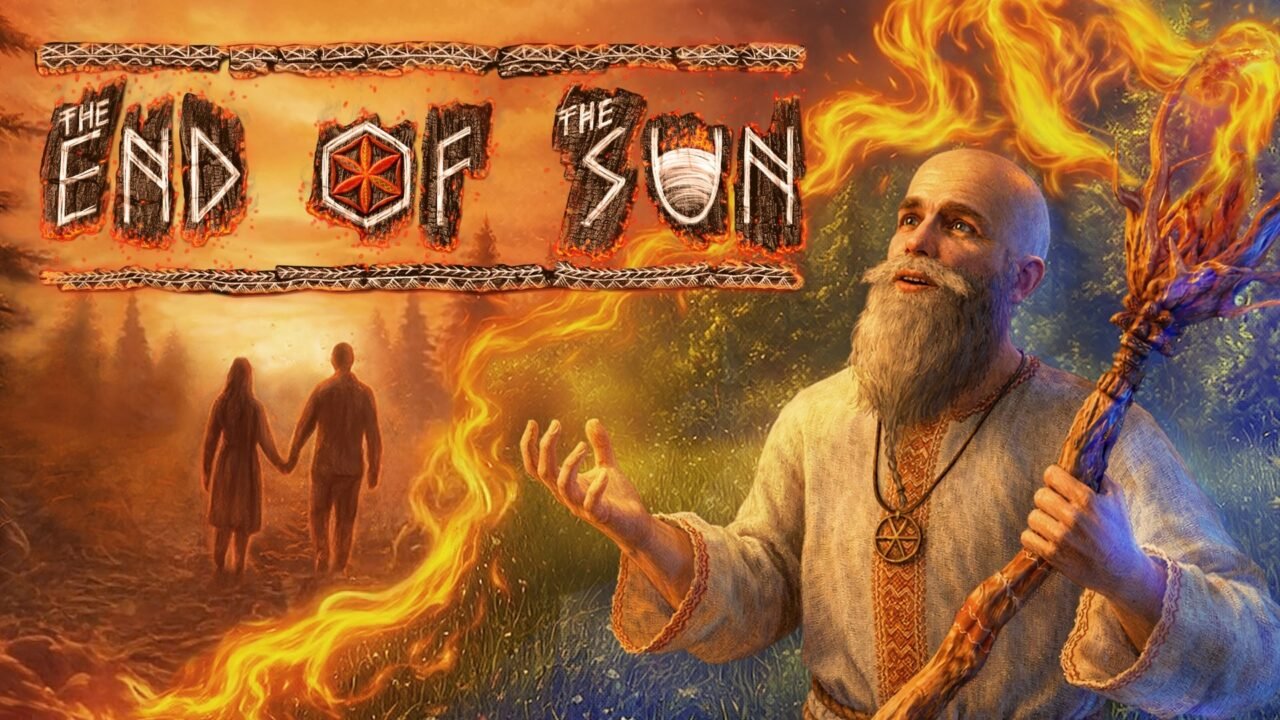
You play the Ashter, a fire mage following a supernatural trail. The village is caught in a disturbance of time, and its hearths provide access to moments that need to be understood and restored.
It also suits players who enjoy folklore for its own sake. Much of the pleasure comes from absorbing customs, objects and everyday rituals, so anyone happy to linger and take in the details will get more out of it than someone racing for the credits.
What works
The seasonal structure gives exploration its purpose. Different seasons also represent different stages of the characters’ lives, so revisiting the same location can reveal a new part of a relationship or explain something that previously seemed out of place. It is not simply a change of scenery.
That structure is what gives the pacing its shape. Rather than following a single line of events from start to finish, you assemble the village’s history from moments scattered across its timelines. Pieces that seem minor early on often gain significance once you’ve seen the same people at another point in their lives, which is a neat reward for paying attention.
Bonfires connect the investigation. Following their trails leads to fragments of events; finding an object or changing a circumstance allows those moments to continue. The larger story then builds from the smaller scenes rather than arriving in one long explanation.
The setting has substantial grounding in real objects and buildings. Photogrammetry brings museum artefacts and traditional architecture into the village, while the changing landscape gives familiar paths a different character across the seasons. That attention to ordinary life matters in a game so dependent on making somewhere feel worth exploring.
Music is another important part of the atmosphere. Its folk-inspired sound supports the setting and helps give the story an identity beyond the usual fantasy backdrop. It does a lot of heavy lifting in quieter stretches, when the walking and searching would otherwise feel thinner. The wider soundscape is less consistent, mind: ambient sound on Xbox can feel a little sparse next to the score.
The Slavic folklore setting is the other big draw. It gives the fantasy a texture that feels specific rather than generic, with traditions and beliefs that shape the village instead of simply decorating it. Fantasy fans tired of the same old castles and dragons will find something genuinely different here.
What doesn’t work for everyone
The puzzle design is relatively simple. A substantial part of the interaction involves finding a missing object and returning it to the right place. Those tasks connect naturally to the story, but players seeking more elaborate deductions may find the mechanical challenge limited. The puzzles are best thought of as a way of moving the story along rather than a test in their own right.
There is also plenty of retracing your steps. Travelling between familiar places can reinforce an understanding of the village, but it can become repetitive when the next useful clue is a long walk away. Navigation demands attention rather than providing a constant pointer to the next objective.
The beginning needs patience as well. Unfamiliar terms, limited guidance and events encountered out of order can make the rules feel unclear before the time-travelling structure falls into place.
Character presentation is less convincing than the environments. Stiff animation and uneven delivery can interrupt scenes that rely on human relationships. Responses to the story itself vary: its gentle, personal approach is an attraction, but it will not deliver the same emotional impact for everyone. Some will find its quiet, domestic stories moving; others may find the story predictable, with cutscenes that slow things down more than they need to.
Verdict
The End of the Sun swaps sword fights for folklore, and it’s all the better for it. The seasonal time-travel structure gives every return trip a reason, the village is grounded in real objects and buildings, and the music does a lot of heavy lifting for the atmosphere. Its weak spots are easy to spot too: puzzles rarely go beyond fetching the right object, there’s a fair bit of walking back and forth, the opening is confusing and the characters are stiffer than the scenery around them.
Still, there’s nothing else on Xbox quite like it right now. If you enjoy slow narrative adventures and fancy a fantasy setting that isn’t yet another castle full of dragons, it is well worth your time. If you want brain-melting puzzles or action, look elsewhere. I’m giving it 8/10.